Record the intent
R-PAY-RETRY states the behavior. The agent or team links it to Service.Charge and the regression test.
Open Software Traceability Format
OSTF connects requirement IDs to code and tests, with optional labeled log and OpenTelemetry references. Tools can check link freshness against a source tree.
01 / THE MODEL
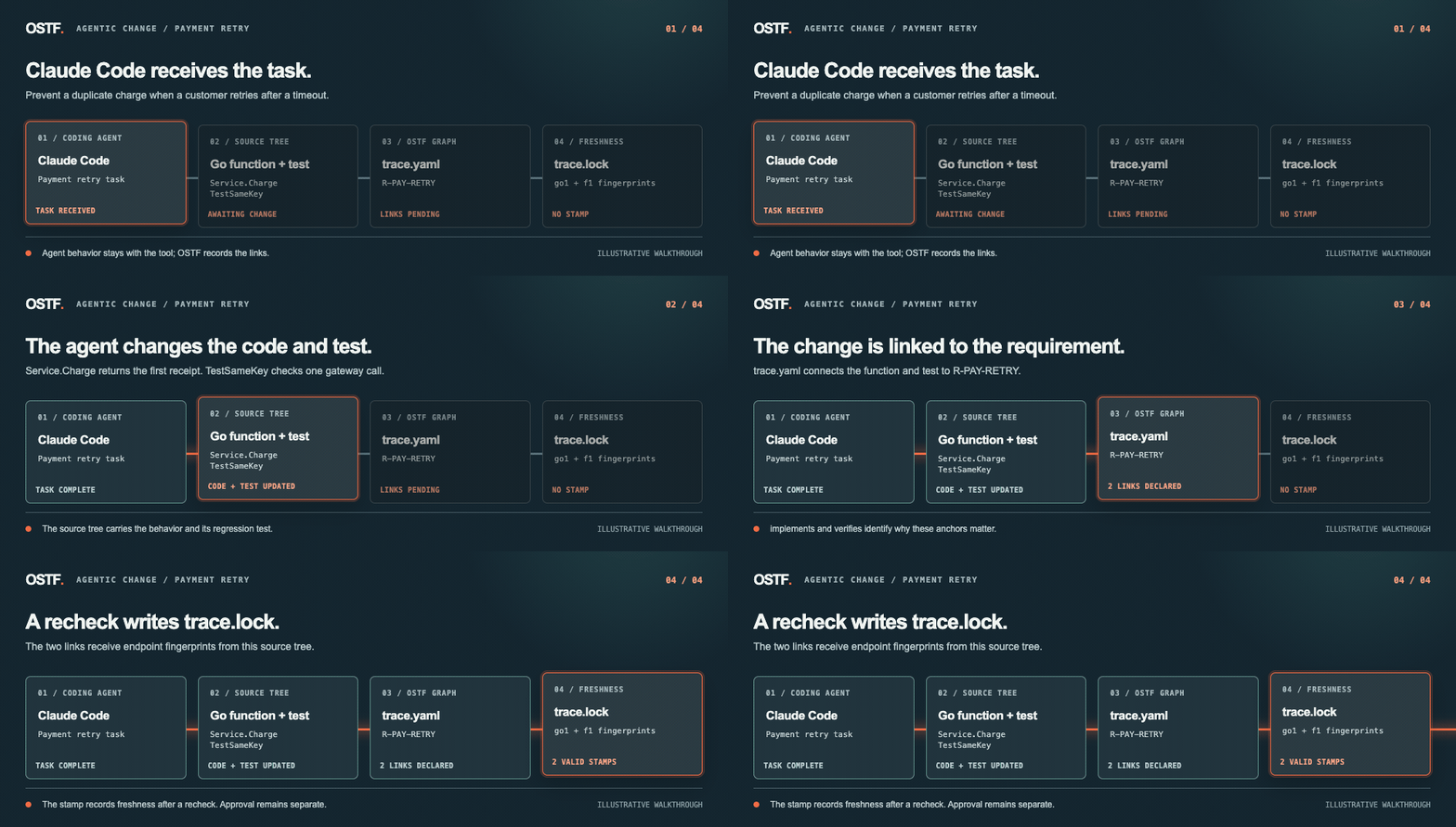
A customer retries a charge after a timeout. An agent updates the payment method and adds a regression test. OSTF links both to the requirement: the same payment idempotency key must not create a second charge.
Prefer links beside code? When tag reading is enabled, a Go comment such as // @req R-PAY-RETRY can declare a link to the following definition. Read the tag rules.
trace.lock entrytrace.lock 1
pay/charge.go#Service.Charge implements R-PAY-RETRY source.sig=go1:GG87juikRDlVftpE_jZHF2al2weX0dAt3ZmIU_ZidfE source.body=go1:MfpzrEnIbxC9-F2ceyJo8KmJK3bn9Dz7epTGGLfzL74 target=f1:-fGQUood7K-GLzAggMrvAssxMIAPcM3ycdApkoOLpMMsource.sig and source.body fingerprint the Go method; target fingerprints the requirement. These are change checks, not a Git commit. The complete file also stamps the verifying test.
R-PAY-RETRY states the behavior. The agent or team links it to Service.Charge and the regression test.
After reviewing the relationships, a tool stamps their endpoint fingerprints in trace.lock.
If a later agent changes Service.Charge's signature, an Analyzer reports its stamped link as suspect so the relationship can be rechecked.
A LATER CHANGE
Imagine a later pull request changes NewService so it no longer initializes the receipts map. The linked method and test stay untouched. Their OSTF stamps can still be valid even though a charge now fails.
Receipts map is no longer initialized.
The linked method still uses that map.
Its regression test is TestSameKey.
The existing links identify the requirement and test to revisit. A valid stamp only describes the fingerprinted endpoints.
Dependency analysis or CI discovers the indirect impact. CI records results; people decide whether the change can merge.
A CLEAR BOUNDARY
A valid stamp means a link meets the draft's freshness rules relative to a recorded recheck. It does not establish approval, correctness, test execution, compliance or release authorization.
02 / THE DRAFT
The specification is maintained in the public OSTF repository. These links go to its current draft source, so the site does not maintain a second copy of the rules.
A Go payment retry service with the requirement, linked test and valid lock stamps shown above.
02 / ORIENTATIONWhat belongs in Core, what remains a proposal and what tools decide for themselves.
03 / NORMATIVE DRAFTVersioned rules for files, items, links, fingerprints and conformance claims.
04 / IMPLEMENTERSFixtures, a prototype reader and the limits of current conformance coverage.
Current normative language and runner coverage: Go. See the support map for implemented and proposed behavior.
Draft status: document revision 0.11, file format 0.2, conformance suite 0.2.0. OSTF 1.0 and independent-party conformance are not yet claimed.
03 / PARTICIPATE
Build an OSTF reader or writer for your coding agent or engineering tools. Try the fixtures, compare results and tell us where the draft is ambiguous. Proposals and decisions are public in the OSTF repository.